How Google's New Search Is Quietly Deciding Which UK Small Businesses Get Found — And Which Don't
LOCAL SEARCH | AI VISIBILITY
How Google's New Search Is Quietly Deciding Which UK Small Businesses Get Found — And Which Don't
You have not done anything wrong. Your website is still up. You are still trading. But something changed earlier this year — quietly, without a press release, without a warning — and it is already affecting which businesses customers find when they search. Here is what happened, in plain English.
By Prakash Gurung MVO | 19 June 2026 | 5 min read
"Google is no longer just a list of links. It is now a search engine that makes recommendations — and most UK small businesses have no idea how those recommendations are made."
Something Changed — And Most People Missed It
Let us be honest: “AI” is one of those words that makes most sensible people switch off. You hear it on the news every week — miracle cure one minute, job-destroying monster the next. If you are running a plumbing business in London or a nail bar in Aldershot, it can feel like background noise. You have invoices to chase and staff rotas to sort. Fair enough.
But earlier this year, something very practical changed inside Google. No robots, no science fiction. Just a new way the search page is laid out — and it directly affects how Google finds local businesses UK 2026 and who gets that first call from a customer nearby.
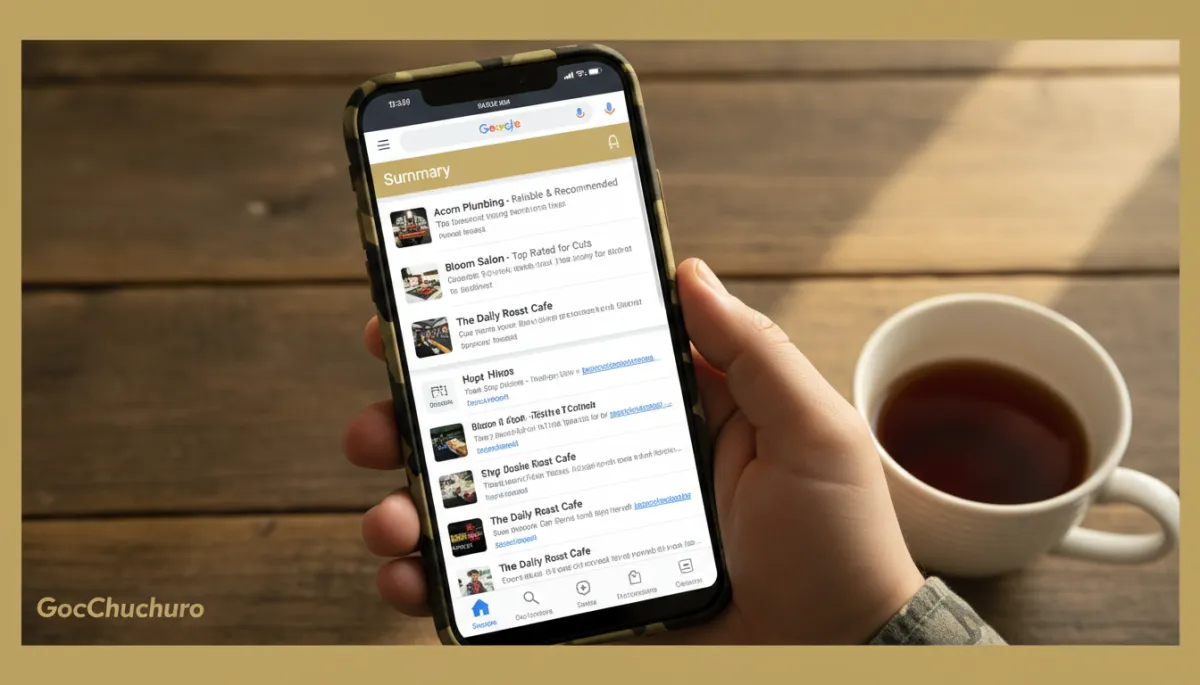
On many searches now, Google has added a summary box right at the top of the page. Before anyone sees the usual list of blue website links, they see a short summary that picks a handful of businesses and describes them — often with wording that sounds very much like a recommendation. Studies this spring suggest that around four in ten local searches in the UK now show this kind of box at the top, and that number is rising in 2026 according to several search industry reports.
That box is now the most visible part of the page. The businesses that appear in it are the first names a customer sees. The ones that do not appear there are pushed further down — sometimes off the screen entirely, unless the person scrolls. This is not a conspiracy and it is not hype. It is simply how Google presents local search visibility UK in 2026. Quietly, it is already deciding which businesses in your area get a fair shot at the enquiry — and which ones never even get considered.
Why a Skeptic Should Still Pay Attention
If your first reaction is, “Here we go, another tech trend, another thing I am supposed to worry about,” I am with you. There is always someone ready to wave a scary headline about local SEO small business UK and then try to sell you a complicated package. A bit of scepticism is healthy. Keep it. It will protect you from wasting money.
Here is the straight version, with no drama. Google has done this because it thinks people want quicker, clearer answers. If someone types “emergency plumber near me” at 11pm, a neat little summary of three trustworthy local options is, frankly, easier than scrolling through ten different websites. From the customer’s point of view, it is handy. From your point of view, it all comes down to whether you are one of those three — or you are quietly bumped below the fold.
Research from UK and European agencies this year suggests that over 40% of local business searches now produce one of these summary boxes. Here is the detail that matters: nearly a third of the businesses that appear in those boxes do not show up in the traditional results underneath. In other words, some firms that were invisible before are suddenly visible. Others that used to sit proudly near the top of the normal results have quietly lost the most visible spot, even if their ranking technically looks similar on paper.
Many owners sense enquiries dipping before they ever see what changed on Google.
The effect is simple and very real: fewer phone calls, fewer website visits, fewer online bookings — even though you have not changed a thing. You do not need to become a digital expert to respond. But you do need to know how Google finds local businesses UK 2026 and what signals it is now paying closer attention to.
What Google Is Actually Looking For (It Is Probably Things You Already Do)
Here is the genuinely reassuring bit. The businesses that show up in these new summaries are not there because they paid someone in Silicon Valley. They are usually there because, on paper, they look like the sort of local business you would happily recommend to a neighbour. No special subscription, no secret code. Just five common-sense things done consistently.
Genuine Google reviews — regular and recent. Google trusts businesses that keep earning feedback from real customers. Not a sudden burst of 100 in a week, but a steady trickle over months and years. A heating engineer with 47 reviews and a 4.7 rating looks active and dependable. One with 8 reviews, all from 2021, looks like they might have packed up their tools.
An accurate, active Google Business Profile. Your hours, address, phone number, photos — all correct, all current. This is one of the biggest signals for Google Business Profile UK small business visibility now. If your Sunday hours are wrong or your phone number changed last year, Google is less confident about showing you in that summary box. A dusty, half-filled profile whispers, “Maybe closed.”
A website that works properly on a mobile phone. Most local searches happen on a phone, often on the move. If your site takes ten seconds to load, or the text is tiny and buttons are hard to tap, people back out — and Google notices. You do not need fancy design. You need fast, clear, and easy to use on a small screen so customers can get what they need without faff.
Clear, useful information on your website. Google favours businesses whose sites actually answer the questions people type in: What do you do? Which areas do you cover? What does it cost roughly? What happens when I fill in the form or ring you? Plain-English pages like “Boiler servicing in Leeds — what we do and what it costs” help you get found on Google UK far more than vague marketing fluff.
Consistency across the web. Your business name, address, and phone number should match on your website, your Google profile, and any directories you are listed on. Old details on a directory you forgot about can make you look unreliable, even if you are doing a brilliant job on site every day.
At GoChuchuro, our philosophy is simple: brilliant people do not struggle for lack of skill. They struggle for lack of the right system. None of this is about being clever. It is about having a straightforward system that keeps these five things in good order without you having to think about it every week.
The Businesses That Will Be Fine — And the Ones That Won't
After nearly forty years in the British Army, one lesson has stuck with me: it is rarely the loudest voice or the fanciest kit that wins. It is the team that prepares properly, maintains their kit, and turns up consistently. Local search visibility UK works the same way. The winners will not always be the ones with the flashiest websites or the biggest marketing budgets. They will be the ones who quietly do the basics well, month after month, without dropping the ball.
They are the tradespeople who ask for a review after every job, as naturally as they send the invoice. The salon owners whose Google profile still shows the right opening hours when the clocks change. The café whose website loads in two seconds on a phone and tells you, in plain English, what is on the menu and how to book a table. These are the businesses that will still be getting that first call in three, five, ten years’ time.
In military terms, the digital equivalent of maintaining your kit is keeping your online presence accurate, active, and honest. That is all. You do not need to understand the inner workings of Google or any of the jargon that goes with it. You just need a simple system that keeps those five things in order — and, ideally, someone alongside you making sure they stay that way while you get on with the work only you can do.
The businesses that end up invisible online in a few years will not be the ones that lacked skill. Many of them will be excellent at what they do. They will be the ones who assumed nothing had changed and never checked. If you are reading this, that is already not you.
THE FIVE THINGS GOOGLE LOOKS FOR
✓ Genuine Google reviews — recent, regular, and responded to
✓ A complete, accurate Google Business Profile — kept up to date every month
✓ A website that loads quickly and works on a mobile phone
✓ Clear, plain-English content that answers the questions customers actually ask
✓ Consistent name, address and phone number across every listing online
Want to Know Exactly Where Your Business Stands?
You do not need to become a digital expert. You just need to know which of these five things your business is already doing well — and which ones need a bit of attention. Book a free 30-minute chat with me and we will go through it together, in plain English, with no jargon and no sales pressure. Just an honest look at where you stand and what, if anything, needs to change so you can keep getting found on Google UK while you focus on running the business.
Book Your Free 30-Minute Chat →
GoChuchuro | gochuchuro.com — Reach Your Peak. Automate Your Growth.