
Too Busy to Automate? You're Falling Behind
BUSINESS GROWTH & AUTOMATION
Too Busy to Automate? That Is Exactly Why You Are Falling Behind
If your phone never stops ringing, your diary is packed, and you still feel like you are treading water, this article is for you. Every week, UK restaurants, salons, plumbers and trades lose hundreds of pounds in bookings they never even see — not because the food is bad or the service is poor, but because no one had time to answer, reply, or follow up. In 2026, that is the quiet gap between businesses that grow and businesses that just grind.
This guide is a warm, honest look at what business automation really means for local business owners in 2026 — and why the ones who say they are “too busy” are usually the ones who need it most.
The Hidden Cost of Constant Rush
You are in the middle of a lunch rush. Someone wants extra chutney, the card machine is flashing, a Deliveroo driver is waiting. Your phone rings. You cannot answer. Later you see the missed call: unknown number. They needed a table for six on Saturday. By the time you call back two hours later, they have already booked somewhere else.
📌 Case Study – London Curry House: A family-run curry house in Southall tracked missed calls for one week and discovered 27 unanswered calls during peak hours. After adding a simple “Sorry we missed you” text-back with a booking link, 18 of those callers either booked or requested a call-back the following week — turning what used to be silent losses into roughly £900 in extra bookings every month.
That is not bad luck. That is a systems problem. And it happens dozens of times a week across UK restaurants, plumbing businesses, salons, and trades — all of them busy, all of them losing customers they never even knew were interested. When 75% of callers who reach no answer simply move on and never ring back, every missed call is not just a lost ring. It is lost revenue, lost referrals, lost reviews.
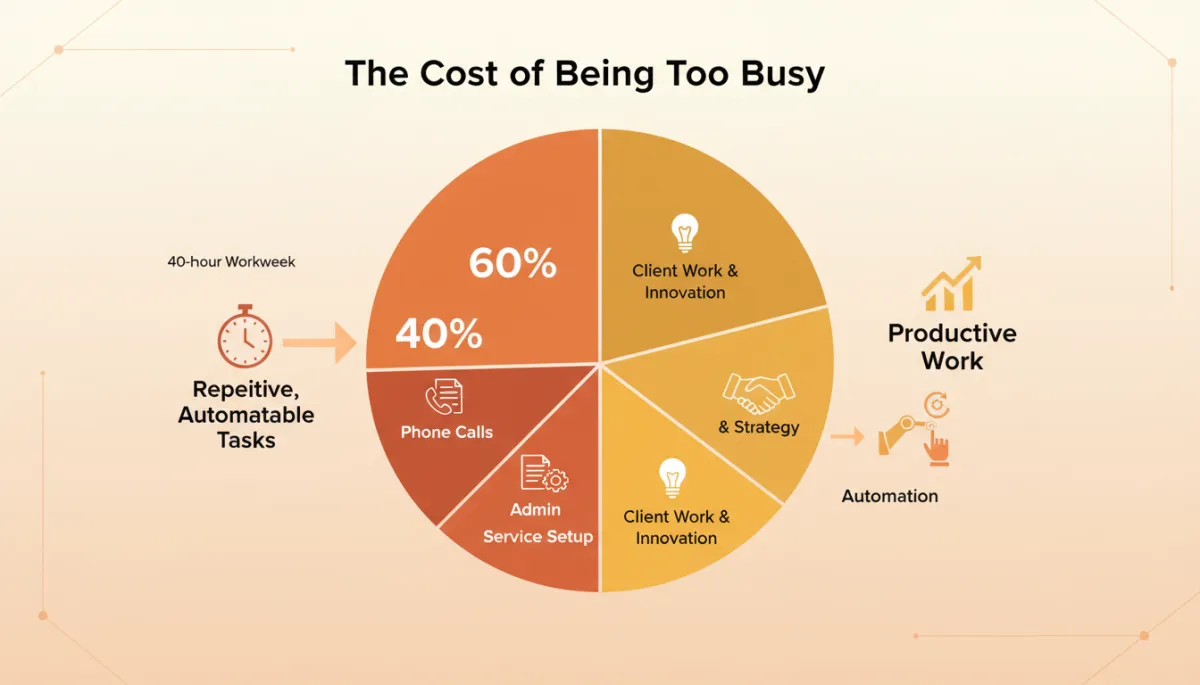
Here is the core irony: the business owners who most need automation are precisely the ones who say they are too busy for it. And “too busy” is itself a symptom of not having the right systems in place. The average small business owner spends over 16 hours a week on repetitive tasks a simple system could handle. That is two full working days — every single week — on things a computer can quietly do while you serve, fix, cook or cut.
What Automation Really Looks Like Day to Day
To solve that systems problem, it helps to clear up what we mean by automation in the first place. When people hear business automation 2026, they picture robots, expensive software, IT consultants, and a week of training they do not have time for. That is the myth. The reality of small business automation UK is much simpler — especially for local businesses like yours.
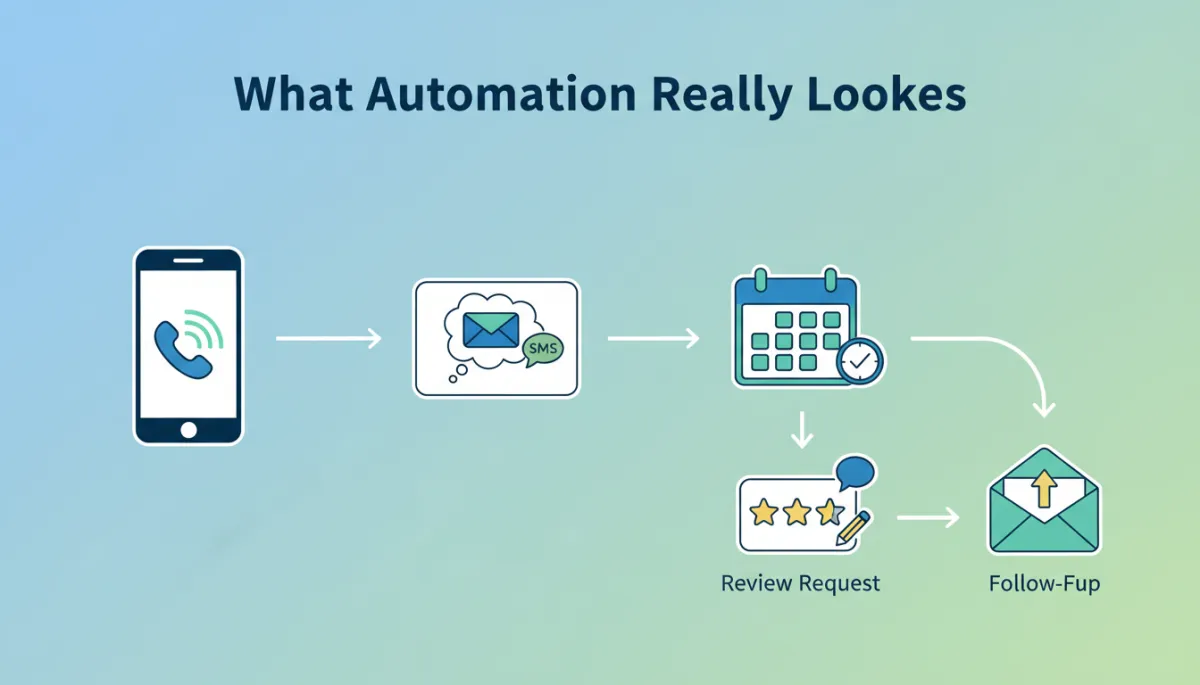
Once you strip away the jargon, automation is often just good customer service that happens automatically. For a restaurant, automation can be a text message that goes out automatically when you miss a call: “Sorry we missed your call — we are with a customer right now. What is the best time to call you back?” For a salon, it is a reminder the day before and the morning of every booking. For a plumber, it is a review request that arrives on the customer’s phone the evening after the boiler is fixed. That is the whole thing. Nothing cold. Nothing complicated. Just small, smart touches that happen every time, without you remembering.
💡 Real Example – Birmingham Barber: A high-street barber in Birmingham set up a basic booking link and automated “running 10 minutes late” texts. Within three months, walk-in chaos turned into 80% pre-booked days, average wait times dropped, and the owner reclaimed about 6 hours a week previously spent juggling calls and messages.
Seen this way, the picture changes completely. Automation does not replace the human. It protects the human moments — by handling everything else. Automation is not a robot replacing the chef. It is the kitchen porter who preps everything, so the chef’s hands never leave the food. The craft stays. The admin disappears. The warmth that makes customers come back is exactly what good automation is designed to preserve.
Data-Driven vs Tradition-Driven Mindsets
To understand why some owners lean into these tools and others hold back, it helps to look at mindset and culture. In much of Western business culture, decisions are increasingly data-driven. If there is evidence that a tool, a method, or a system works, it tends to get tried, tested, and refined. There is a comfort with change when the numbers support it, and a willingness to hand boring tasks to systems so humans can focus on higher-value work. That comfort is one reason automation adoption has raced ahead in many Western markets, with studies showing businesses that adopt automation tools see around a 14.5% increase in sales productivity.
On the ground, that often looks very ordinary — and very practical. It might be a café owner plugging their phone line into a missed-call text-back system, a tradesperson using a simple job management app like Tradify or Jobber, or a high-street barber using Calendly or a built-in booking tool so customers can schedule online. None of these tools change the coffee, the quality of the work, or the sharpness of the fade. They simply make sure enquiries are captured, bookings are organised, and customers get timely reminders without the owner living inside the diary.
“When we finally stopped relying on a paper diary and my memory, our evenings went from frantic to calm. The work stayed the same — the way it arrived just became manageable.”
— Owner of a family-run café in Bristol, after three months of using automated booking and reminders
By contrast, many Eastern and diaspora business owners — South Asian, Nepali, East Asian — come from a different, equally valid tradition. You learned by watching and doing. A parent, an uncle, an older colleague showed you how to greet regulars, how to season the curry, how to price a job so nobody feels cheated. That knowledge is real. The warmth, the recipes, the trust built over decades — no spreadsheet can replace that, and it should not try.
Respecting Tradition While Adapting
However, even the strongest traditions have to live in the present day. Some of those practices were right for a different time. The reluctance to change is often not stubbornness; it is loyalty. Loyalty to what worked. Loyalty to the people who taught you. Underneath, there is a quiet fear: if we change how the business works, do we change what the business is? If we bring in new tools, do we somehow dilute the culture and heritage our customers love?
That fear deserves respect. And it also deserves a gentle challenge. Because your customers are changing. They are on Instagram. They walk past your shop with headphones in, looking at their phones. They book on their phone, often while standing right outside your front door. They leave reviews from the car park. They bring their children, who do all this without thinking and quietly wonder why their favourite restaurant does not have an online booking link or why their barber only takes calls between cuts. A simple “Book Now” link in your Instagram bio, a WhatsApp Business profile with quick-reply messages, or a Google Business Profile that lets people message and book directly are small, concrete steps that meet those customers where they already are.
📌 Case Study – Nepali-Owned Takeaway in Reading: This takeaway added a “Book Now” button to Google, a WhatsApp Business profile, and auto-replies in English and Nepali. Within six months, online orders grew by 28%, Friday-night phone queues disappeared, and their Google rating climbed from 4.1 to 4.6 as more happy customers left reviews.
Openness, Help, and the Lighthouse Metaphor
And underneath all of this sits something deeper than tools or tactics. Real growth in any culture starts with the same sentence: “I do not know everything.” The willingness to ask what is out there, to say where you are struggling, and to see if there is a better way. In many Eastern cultures, asking for help in business can feel like admitting failure. But that kind of openness — that vulnerability — is not weakness. It is courage. And it is often the line between the businesses that quietly thrive and the ones that quietly close.
If you need a picture for this kind of change, imagine this. Think of a lighthouse keeper who learned everything from their father — the tides, the weather, the timing of the light. That knowledge kept ships safe for generations. When the keeper replaced candles with an electric light, they did not betray the tradition. They made it stronger. The light still shines. It just goes further now. Automation in your local business is the same. The heart stays. The beam reaches more people — including the ones walking past your door, scrolling for somewhere to book tonight.
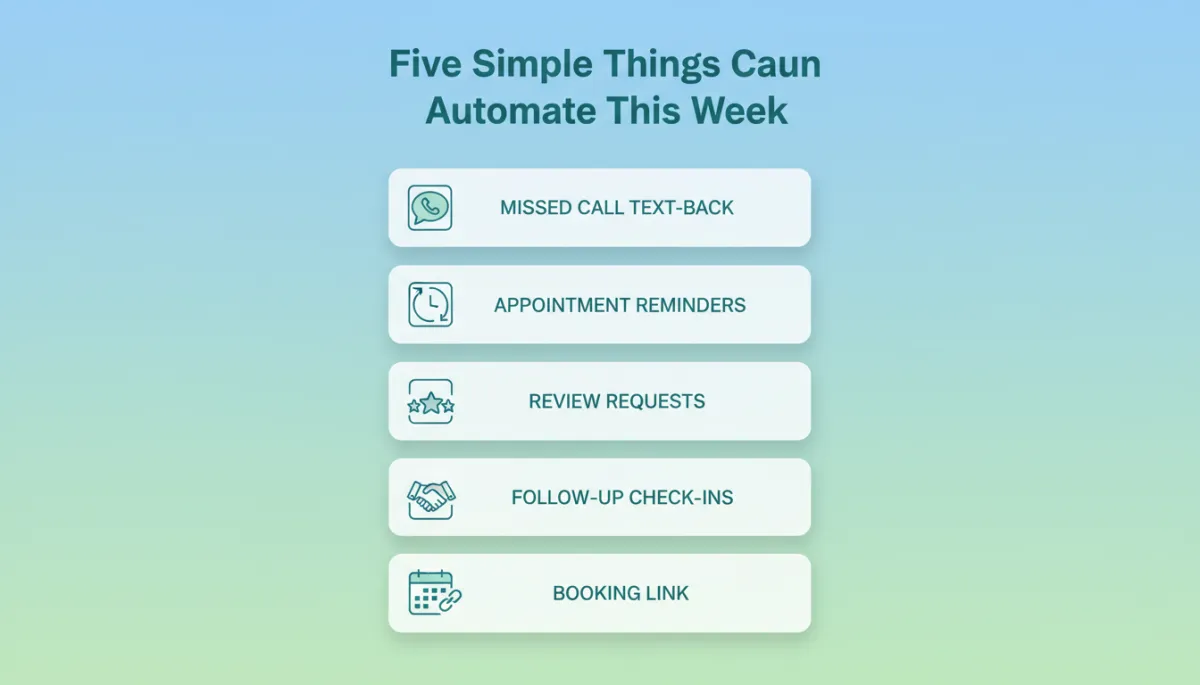
Five Quick Wins You Can Automate This Week
With that mindset in place, the next question is practical: where do you start? You do not need a full digital transformation. You just need a few small wins that prove to you — and your team — that automation can quietly work in the background.
1. Missed call text-back. Phone rings while you are on a job or serving a table. You cannot pick up. An automatic text goes out within seconds: “Sorry we missed your call — we are with a customer right now. What is the best time to call you back?” That lead stays warm instead of going to a competitor. A plumber in Sheffield set this up in 20 minutes and recovered three jobs in the first week. This is missed call text back in its simplest form — and it works.
🔍 Real Example – Sheffield Plumber (Numbers Behind It): Before automation, this sole trader averaged 10–12 enquiries a day and suspected he was losing a few. After installing missed-call text-back, he tracked responses for a month: 41 missed calls, 29 replied to the text, and 17 turned into paid jobs. At an average of £180 per job, that is over £3,000 in revenue recovered from calls he previously would have simply missed.
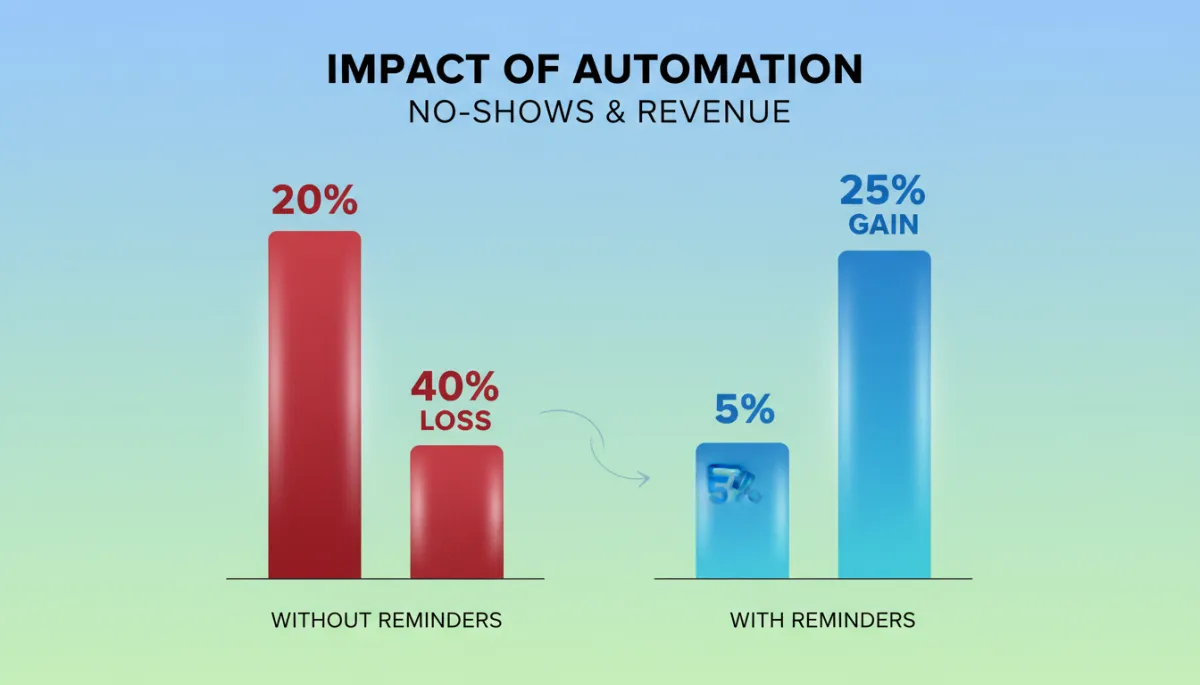
2. Appointment reminders. Once you are catching more enquiries, the next step is making sure the bookings actually turn into visits. A salon in Birmingham added automatic texts the day before and the morning of every booking. Within a month, no-shows dropped by about a third. Across industries, businesses using automated appointment reminders see 30–40% fewer no-shows. That is money you have already earned, actually arriving.
“We went from four or five empty chairs a day to maybe one. The reminder texts paid for themselves in the first week.”
— Owner, Birmingham salon specialising in South Asian bridal hair and beauty
3. Review requests. After every meal, haircut, or boiler repair, a short message goes out that evening: “We hope everything went well — if you have a moment, a quick review really helps us.” Most customers are happy to help when asked at the right time. Most businesses never ask at all. In a world where 62% of consumers expect fast responses on digital channels, reviews are part of how people decide in seconds whether to choose you or the next listing.
📈 Case Study – East African Café in Leicester: By turning on automatic review requests after every bill was paid, this café went from 23 Google reviews in three years to over 120 reviews in eight months. Their rating improved from 3.9 to 4.5 stars, and they now appear in the top three results for “Ethiopian food Leicester” — driving a noticeable rise in weekend bookings.
4. Follow-up check-ins. Once reviews are flowing, you can deepen those relationships. Two or three days after every job, an automatic message: “Hi [name], just checking everything is still going well. Let us know if there is anything you need.” It feels deeply personal, costs almost nothing, and takes 10 minutes to set up once. This is how local business systems quietly build loyalty while you sleep.
“Customers started replying, ‘Thanks for checking in, I have been meaning to ask about…’. Those follow-ups turned into extra work we would never have known about.”
— Gas engineer in Manchester after adding automated check-ins
5. A simple booking link. Finally, make it easier for people to say yes to you. One link that you can send on WhatsApp, put in your Instagram bio, or add to your Google profile. A customer taps it, chooses a time, and books without a phone call. Five minutes of setup. Hours saved every week. For many diaspora customers who prefer messaging to calling, this is not just a nice extra. It is the reason they book with you instead of someone else.
💬 Real Example – Home-Based Henna Artist in Luton: After adding a booking link to Instagram and auto-replies in English and Urdu, this artist reduced back-and-forth DMs by about 70%. She now books most Eid and wedding appointments two weeks earlier than before, giving her clearer income visibility and less last-minute stress.
2027: From “Nice to Have” to “Of Course”
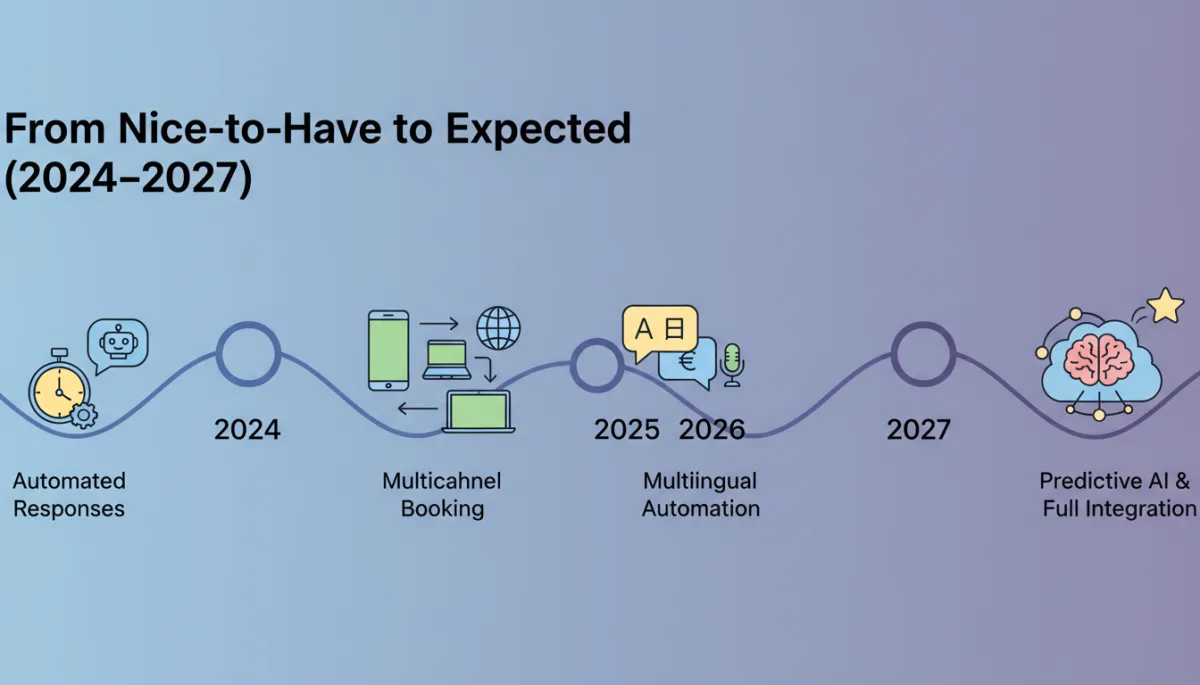
Put together, these small steps point towards a bigger shift that is already underway. By 2027, these things will not impress anyone. They will simply be expected:
A business that answers every enquiry — even at midnight — with a warm, intelligent automated response.
A booking or contact system that works across WhatsApp, Instagram, Google, and phone without you juggling them manually.
A follow-up process that remembers every customer and checks in at the right moment.
For UK businesses serving Nepali, South Asian, East African, and East Asian communities, multilingual automation will move from special to standard. Systems that reply in English to one customer and in their mother tongue to another are already being built. The businesses that are comfortable with these tools by then will find it natural. The ones that wait will find it overwhelming — and hard to catch up, because by 2027 the businesses with strong contact lists, automated follow-up, and review pipelines will have a structural advantage that late adopters cannot easily close.
Start Small This Week, Reap the Rewards Next Year
All of this can sound big and far away, but it really comes down to what you do in the next few days. The work you do this week — setting up a missed call text-back, adding appointment reminders, creating a booking link — is not just a quick fix. It is the start of the system that will carry your business into 2027 and beyond. In a world where businesses using automation see clear gains in time, revenue and peace of mind, “too busy to automate” is becoming another way of saying “too busy to grow”.
📌 Key Takeaway:The businesses that win are not the ones with the fanciest tools — they are the ones who stop letting missed calls, forgotten follow-ups, and diary chaos quietly drain their time and money. A handful of simple automations can protect your human touch, serve modern customers the way they expect, and free you to focus on the work only you can do.
Book a Free Chat with GoChuchuro
If any part of this has hit a nerve, let us talk. Book a free chat with us — a GoChuchuro consultation, Monday to Friday, 9am–5pm. One conversation. No pressure. Just a plain-talking look at what your restaurant, salon, plumbing business or trade could look like with the right systems in place, so you can focus on the work only you can do.
Here is how to take action today:
Pick one small win — missed call text-back, reminders, reviews, follow-ups, or a booking link — and decide to set it up this week.
Bring your questions — about your customers, your culture, or your current systems — to a free GoChuchuro call, and we will map out what makes sense for you.
Share this guide with a fellow owner — a friend, cousin, or neighbour on the high street — and start the conversation about building stronger, calmer businesses together.
💡 Pro Tip: Do not wait until you “have time.” Book the chat now, even if it is for next week. Putting a date in the diary is often the difference between another year of firefighting and finally building the systems that let your business — and your community — thrive.
GoChuchuro | gochuchuro.com / Reach Your Peak. Automate Your Growth.